
By the time of the Roman Empire, only a few people could read hieroglyphs, which began to move away from their original purpose of conveying a message, and became more a display of erudition, with symbols that could be understood only by those with special knowledge. There is a good introduction to hieroglyphic writing during this period by C. Thiers, "Ptolemaic Writing" ( PDF ). For a discussion of the style of hieroglyphs at Esna, see D. Klotz, "Hieroglyphic Complexity at Esna" ( PDF ).
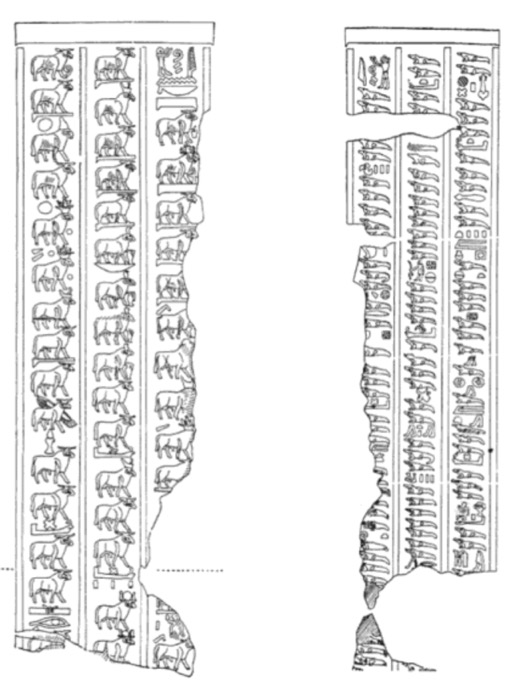
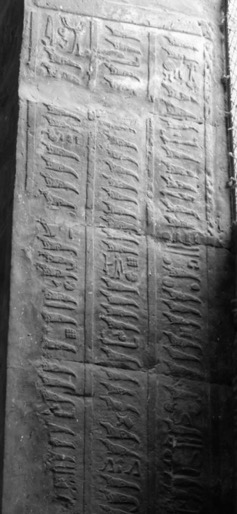
The composer of these two famous hymns took things one stage further, and produced a sequence of symbols that even an expert in hieroglyphs would find difficult to understand. They were placed as a matching pair in the pronaos of the temple in Esna; one consisted almost entirely of ram signs, and the other consisted almost entirely of crocodile signs.
Since the time of Champollion, Egyptologists have naturally enjoyed the challenge of trying to decipher these hymns. As a result of their labours, it is now possible to produce a reasonable translation of the "Ram Hymn": see David Klotz's translation of Esna II.103. However, the "Crocodile Hymn" is more difficult, and it does not help that it has suffered considerable damage; see the comments of David Klotz on Esna II.126, and also the remarks of A. Stauder, in "The Hidden Language of Graphic Signs", pp.44-46 ( Google Books ).
Below are a drawing of the best preserved parts of both hymns (detail from A. Stauder, op.cit.), and a photo of the "Crocodile Hymn" in situ (source unknown).
| 
|
Attalus' home page | 04.07.26 | Any comments?