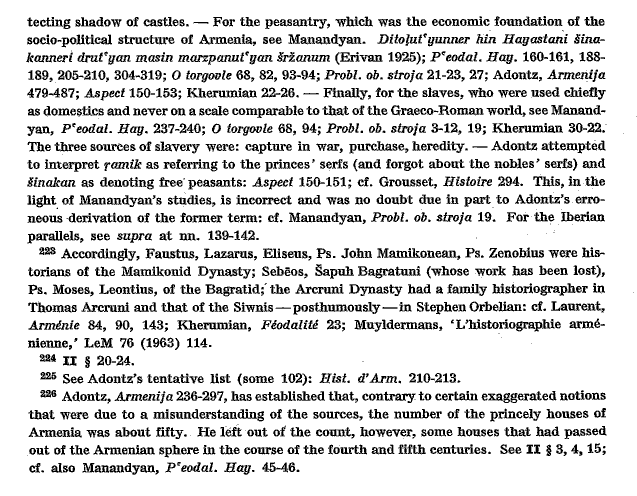
Though jejune regarding the lesser noblesse, the national historians, be it repeated, contain ample information of a genealogical, onomastic, geographical, and political nature relative to the dynastic aristocracy. In fact many of the historians were historiographers of particular princely families (223). Some of them, moreover provide us with partial lists of the princes from which their relative precedence can be inferred (224). Now, Arsacid Armenia appears divided into some fifty princely States--about half the number of the States that were, according to Urartian sources, under the aegis of the Vannic Great Kings (225)--held by some thirty dynasties. The exact number of the Armenian Princes, successors of the Urartian sub-kings, did not, quite naturally, remain stationary, but varied in the course of history, owning to the fact that the outlying princely States occasionally fell away from the Armenian Crown; that several of, especially, the more important dynasties tended to form subsidiary States as secundo-genitures or tertio-genitures; and that, on the other hand, some dynasties would accumulate princedoms, either peacefully through inheritance or investiture, or violently through conquest (226). Geopolitically, Great Armenia was composed of central and zonal territories, the latter being rather more Armenianized than truly Armenian. The southern semicircle of